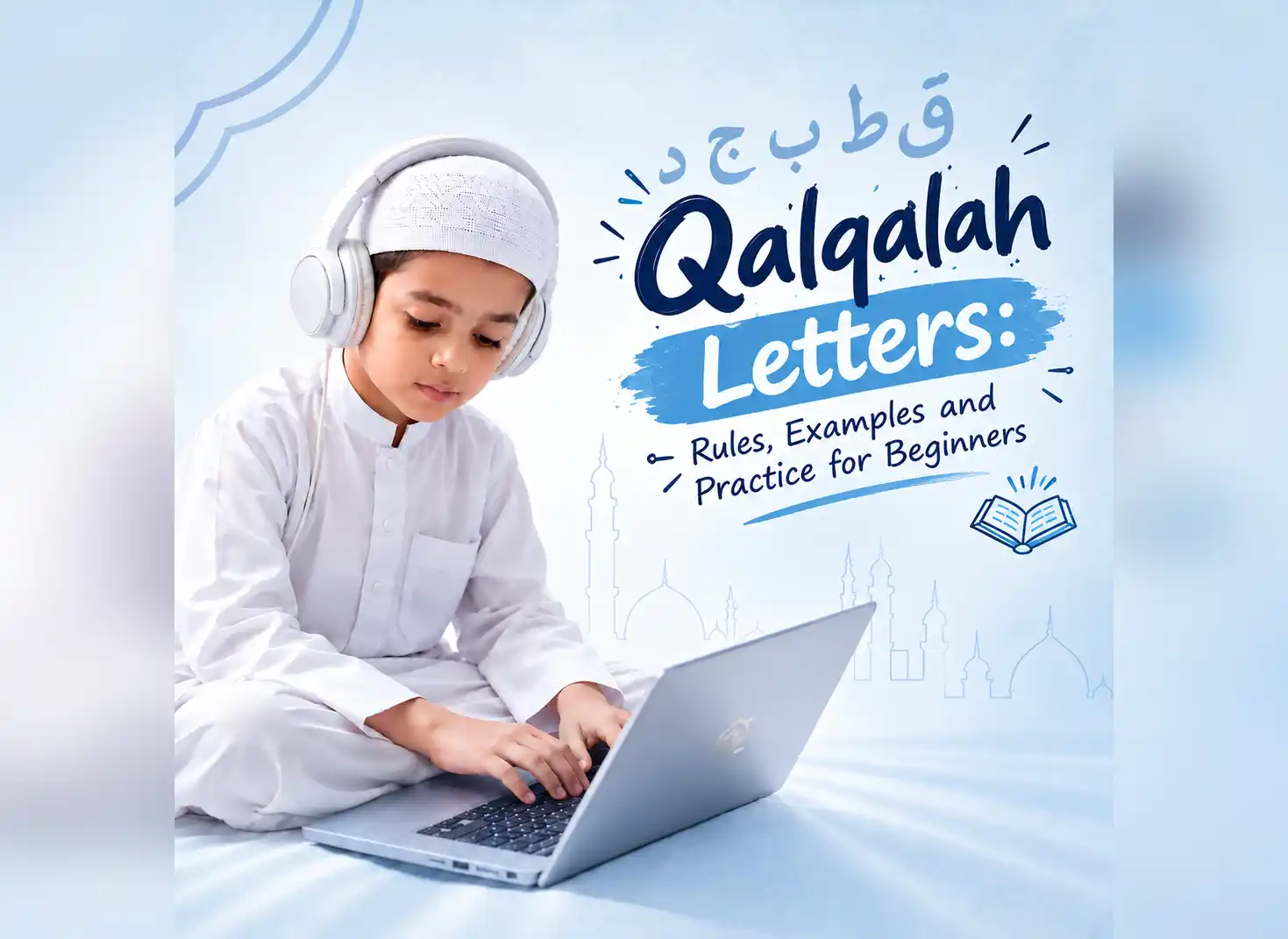
Learning how to pronounce these letters correctly is one of the most exciting milestones in a student’s Tajweed journey. Whether you are an adult perfecting your recitation or a parent searching through a guide for the Best Online Quran Classes for Kids in the USA, understanding these rules is essential. In this guide, we will break down the rules, types, and examples of Qalqalah in plain English.
What is Qalqalah in Tajweed?
In the Arabic language, the word qalqalah literally means shaking, echoing, or bouncing. In Tajweed (the rules of Quranic recitation), it refers to a distinct echoing sound made when pronouncing certain letters.
The core of the qalqalah rules is simple. You only make this echoing sound when the letter has a Sukoon (a symbol meaning the letter has no vowel) or when you stop on that letter at the end of an Ayah (verse). But why do we bounce them? These specific letters are produced by tightly closing the vocal organs. If you do not bounce them, the sound gets trapped, and the letter cannot be heard clearly!
The 5 Qalqalah Letters (The “Qutb Jad” Rule)
There are 28 letters in the Arabic alphabet, but only 5 of them are qalqalah letters. These special letters are:
- Qaf (ق)
- Taa (ط)
- Baa (ب)
- Jeem (ج)
- Daal (د)
To make it easy for beginners and kids to memorize, scholars grouped these five letters into two simple words: Qutb Jad (قُطْبُ جَدّ). Whenever you see one of these letters with a Sukoon, or whenever you stop on one at the end of a sentence, you must apply the bouncing sound.
Learn Tilawah & Tajweed Mastery with Quran From Home
Types of Qalqalah: Sughra vs. Kubra
To read the Quran perfectly, you need to know that the bouncing sound changes depending on where the letter is located in a word. There are two main types you should know:
Qalqalah Sughra
Qalqalah sughra happens when a Qalqalah letter appears in the middle of a word or the middle of an Ayah, and it carries a Sukoon. Because you are continuing your recitation to the next letter, the bounce is quick and subtle. It is a “minor” echo that keeps the flow of reading smooth.
Qalqalah Kubra
Qalqalah kubra happens when a Qalqalah letter appears at the end of an Ayah, or when you purposely stop on it. Because you are stopping, the bounce is much stronger and more pronounced. This “major” echo is very clear to the listener.
Learn Arabic Online course with Quran From Home
Real Qalqalah Examples from the Quran
The easiest way to understand Tajweed is through practice. Here are some simple qalqalah examples from short Surahs that most kids and adults already know:
- Example of Kubra (Major): Read Surah Al-Ikhlas. The first verse ends with the word Ahad (أَحَدٌ). When you stop on the Daal (د), you bounce it strongly: Ahad-d.
- Example of Sughra (Minor): Look at Surah Al-Falaq, verse 3. The word waqab (وَقَبَ). If you stop on it, it is a Kubra bounce. But look at the word Khalaq in verse 2 (خَلَقَ). If a Qalqalah letter has a Sukoon in the middle of a word like Iqra (اقْرَأْ), the Qaf (ق) gets a small, quick bounce.
Learn Quran from Scratch on Quran From Home for readers starting from zero.
Common Mistakes Kids Make (And How Parents Can Help)
When kids first learn the qalqalah letters, they often make one major mistake: they add a full vowel instead of an echo.
For example, instead of a subtle bounce on the letter Baa (ب), they might accidentally say “Ba-a,” adding a Fathah (an “a” sound). To help your child at home, have them place their hand on their throat. The bounce should feel like a quick release of air, not a full opening of the mouth. Practice with them for just 5 minutes a day using familiar Surahs like Al-Ikhlas and Al-Falaq.
Read more: What Is Juz Amma?
Best Online Quran Classes for Kids in the USA: A Parent’s Guide
While practicing at home is wonderful, Tajweed is an auditory science. It must be heard and corrected by a professional. This brings us to a crucial topic: finding the right support.
If you are reading the Best Online Quran Classes for Kids in the USA: A Parent’s Guide, you know that American families need flexibility. You also need native Arab tutors who speak fluent English. A certified teacher will instantly catch if your child is mispronouncing qalqalah sughra or qalqalah kubra. They turn a frustrating practice session into a fun, interactive game. Getting expert help ensures your child memorizes the rules correctly from day one.
Read more: How to Make Khatm Quran Dua After Finishing?
FAQs (People Also Ask)
1. What are the 5 qalqalah letters?
The five letters are Qaf (ق), Taa (ط), Baa (ب), Jeem (ج), and Daal (د). You can remember them with the phrase “Qutb Jad.”
2. When do you apply qalqalah rules?
You apply the rule when one of these five letters has a Sukoon (no vowel) or when you come to a full stop on the letter at the end of a word.
3. What is the difference between sughra and kubra?
Sughra is a minor, quick bounce that happens in the middle of a word. Kubra is a major, strong bounce that happens when you stop at the end of a word.
Master Tajweed with Quran From Home
Mastering the qalqalah letters is a beautiful step toward reciting the Quran exactly as it was revealed. However, you do not have to teach your family these rules alone.
At Quran From Home, we specialize in making Tajweed easy, engaging, and fun for non-Arabic speakers. Our certified tutors provide one-on-one attention, ensuring you and your children pronounce every letter perfectly.
Ready to hear your child recite with a beautiful, accurate echo?
Book your free trial class with Quran From Home today and experience the best online Quran education available!